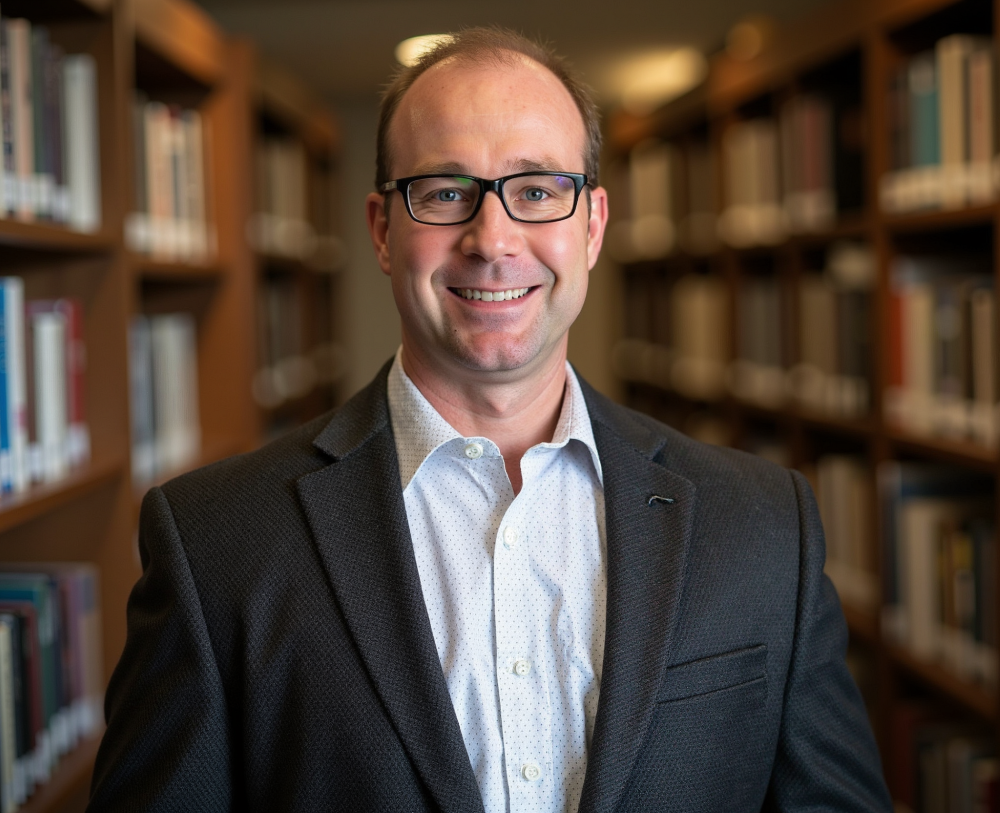
I help founders, leaders, and innovation teams turn uncertainty into proofs of concept, product strategies, and persuasive narratives that move.
The future is not predicted. It is prototyped.
Most consultants arrive after the problem is defined. Most copywriters show up after the strategy is set. Most product teams need a roadmap before they can move. I work earlier than that.
I enter the fog: the undefined problem, the emerging trend, the half-formed product idea, the strategic question nobody has had the patience to solve. My job is to stay with it until form appears.
"Daniel works where ideas are still unstable. He helps them become real enough to test, explain, fund, build, and sell."
I am a Proof-of-Concept Futurist, product strategist, nonfiction author, and AI-assisted builder. My work blends futurism, systems thinking, product strategy, AI-assisted development, and persuasive writing into one thing: movement from fog to form.

Organizations are full of brilliant people. But their most important ideas tend to die in meetings, dissolve into vague strategy language, or sit half-finished in documents nobody reads twice.
Nobody gets stuck because they lack intelligence. They get stuck because turning a raw, messy idea into something testable requires a particular kind of patience, range, and structured imagination that most teams simply do not have the time to apply.
That is where I enter. I walk into the mess, name the real problem, and stay until the path appears.
Six stages that move a team from an unstable idea to a working artifact. Not improvisation. Structured imagination with execution attached.
Most teams try to solve the first version of the problem. I slow down long enough to find the real one, the constraint hiding underneath the stated challenge.
Trends, weak signals, market shifts, user behavior, technology, and adjacent industries. The landscape reveals what the problem is asking of you before you decide how to respond.
Every problem lives inside a system. I identify the people, incentives, blockers, tools, assumptions, and hidden friction that shape what is actually possible.
Multiple plausible approaches, not just the first idea that sounds good. The best path rarely reveals itself before you have mapped the alternatives.
The strongest path becomes something people can react to: a prototype, a brief, a landing page, a pitch, a product spec, a narrative, or an AI-assisted workflow.
Document what was learned, what should happen next, and how the concept should be explained, tested, built, or sold. The proof becomes a decision.
Each engagement follows the journey from undefined challenge to usable artifact. The format changes. The job stays the same: work the problem until the next right form appears.
A focused assessment for leaders with a strategic, product, market, or messaging problem that is not yet clearly defined. You leave with a problem framing brief, assumption map, opportunity ranking, and a practical next-step roadmap.
A 2 to 4 week engagement that turns a raw idea or unresolved problem into a proof-of-concept package. Market research, solution hypotheses, product concept, initial prototype or landing page, and a validation plan. Before you build for months, create enough proof to know what is worth building.
For teams that need to understand what is changing before they decide what to build. Trend discovery, weak-signal scanning, scenario thinking, and an emerging opportunity map. See the future clearly enough to make a better move now.
For teams that have built something useful but cannot explain why it matters. Positioning, message architecture, homepage copy, sales narrative, pitch deck, founder story, and objection handling. A good product still needs a story strong enough to carry it into the market.
For teams that want to move faster without becoming generic. AI workflow design, content system architecture, voice and message guides, prompt libraries, and editorial quality gates. Use AI to accelerate judgment, not replace it.
A facilitated innovation sprint for leadership teams, founder groups, or accelerators attacking a hard problem. I gather inputs, organize the intelligence, pressure-test the ideas, develop concepts, and document a practical path forward. Bring the hard problem. Leave with proof.
My best-fit clients are not everyone. They are people with complex, valuable, partially formed ideas and the ambition to see them become real.
You are probably a good fit if you are building something new, navigating a market shift, or sitting on an idea that keeps getting stuck between strategy and execution.
These are the moments where the work begins.
Somewhere in the rush toward automation, a quieter truth keeps surfacing: the most powerful thing about AI is not what it can do on its own. It is what it helps humans do better. The judgment, the empathy, the creative leap, the ability to sit with ambiguity and find the shape inside the mess. Those remain yours.
My work is grounded in the belief that the future belongs to teams who can turn uncertainty into proof faster than everyone else, without losing the humanity that makes proof worth anything.
The future is not one fixed outcome. It is a set of possibilities worth preparing for. Good foresight helps you make better decisions now, not predict what happens later.
An idea is a starting point, not an asset. The asset is proof: something real enough to test, explain, fund, and build toward. That is where ideas become decisions.
Authenticity, imperfection, and emotional connection are what make work meaningful. AI can accelerate output. Your insight and intent turn that acceleration into impact.
You start with uncertainty.
You end with proof.
Daniel Stouffer is a builder of possible futures. He enters the room before the answer exists, helps smart people attack hard problems, finds the hidden shape inside the chaos, and turns that shape into something real enough to test. The result is not just a recommendation. It is a proof-of-concept, a product direction, a narrative system, or a decision-ready artifact that helps leaders see what is possible and what to do next.
Bring Me Your Impossible ProblemTell me about the problem. The messier and more undefined, the better. That is exactly where this work begins.
We will talk through what you are trying to build, what is getting in the way, and whether there is a path forward worth exploring together. No pitch. No pressure. Just a focused conversation about what is possible.